Komori Logo

Kyobashi, Tokyo · Est. 1923 · Kando Printing Machinery

Applications

Komori Presses Across Four Production Contexts

One press architecture — four working contexts. Commercial printers, folding-carton converters, publication producers and direct-mail houses all run Komori presses, but the configuration, substrate envelope and service tier that fits each is measurably different. This is the detailed profile of each.

Profile 01

Commercial & Marketing Printers

Mid-run brochures, catalogs, annual reports and premium marketing collateral for regional agencies, in-plant print rooms and specialty commercial shops.

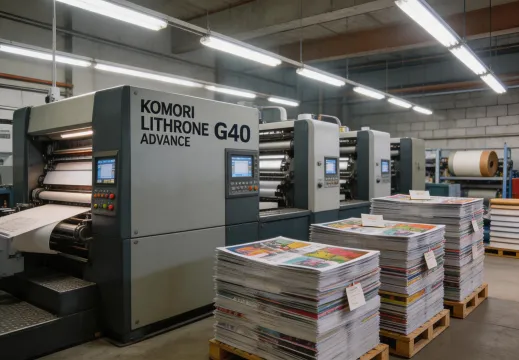
Commercial printer pressroom with Lithrone G40 in operation

Production Envelope

  • Typical run length3,000 – 30,000 sheets
  • Substrate mixCoated 80 – 300 gsm, uncoated 60 – 170 gsm
  • Color targetG7 Master workflow, Delta-E < 2
  • Preferred curingLED-UV for quick turn, inline coating for premium finish

Recommended Komori Configuration

Lithrone G40 Advance with KHS-AI Advance closed-loop color, LED-UV curing and optional inline inspection system. KP-Connect Pro for multi-shift OEE visibility across the pressroom.

Operational Notes

Commercial shops benefit most from KHS-AI make-ready reduction when job counts per shift are high and job-to-job substrate change is frequent. Where jobs are mixed, operator training on the KHS auto-setup sequence pays back fastest.
Profile 02

Folding Carton & Packaging Converters

Folding-carton, rigid-box and premium packaging producers running heavy board, metallic substrates and multi-spot color work for brand owners with Pantone-grade tolerance.

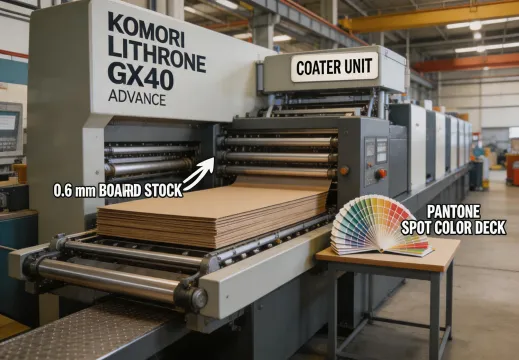
Folding carton packaging plant with Lithrone GX40 coating unit

Production Envelope

  • Board range0.25 – 0.8 mm SBS / FBB / CRB
  • InksCMYK + 2 – 4 Pantone spot + varnish / coating
  • Color targetBrand-owner Pantone bridge tolerance
  • FinishingInline coating, offline hot-foil / emboss

Recommended Komori Configuration

Lithrone GX40 Advance with 7+ color units, coater, parallel drum transfer, LED-UV and inline color measurement. KP-Connect Pro with job-change analytics for brand-owner audit trail.

Operational Notes

Heavy-board runs punish gripper chains and blankets harder than commercial work; the Production or Premium service tier is typical. Parallel drum transfer is the differentiator versus single-drum transfer at 0.6 mm+ board.

Profile 03

Publication & Book Producers

Long-run book, journal, magazine and publication-insert producers where signature consistency, register stability and cost-per-impression drive the economics.

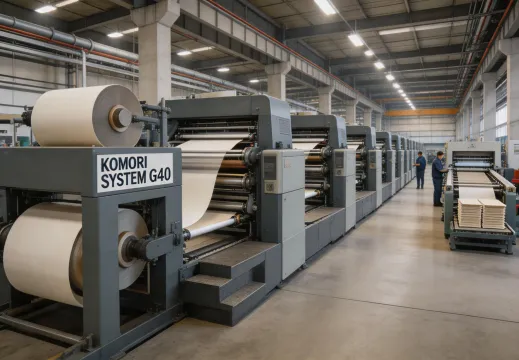
Publication book printing plant with System G40 web press line

Production Envelope

  • Typical run50,000 – 500,000 impressions
  • SubstrateBook paper 60 – 100 gsm, coated art 80 – 150 gsm
  • Register target± 0.05 mm signature-to-signature
  • FinishingInline folding, offline perfect binding / saddle stitch

Recommended Komori Configuration

System G40 web offset for publication, or Lithrone G44 large-format sheetfed for ultra-premium book work. KP-Connect Pro telemetry into the MIS for unit-cost tracking.

Operational Notes

Publication shops prioritize long-horizon parts policy — web presses run for decades, not years. Genuine-only parts supply and certified engineer service is what keeps a 15-year-old System G40 running inside its original envelope.

Profile 04

Direct Mail & Variable Data Producers

Direct-mail houses, transactional-promotional producers and short-run specialty shops where variable data imaging and short-run economics outweigh offset's long-run cost advantage.

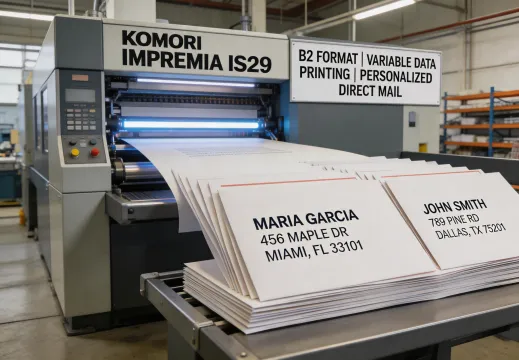
Direct mail production with Impremia IS29s digital press

Production Envelope

  • Short-run bandBelow 3,000 impressions typically digital
  • DataPDF/VT or equivalent variable-data payload
  • SubstrateUncoated, coated, light carton
  • Crossover noteAbove ~5,000 impressions, Lithrone G29 often pencils out

Recommended Komori Configuration

Impremia IS29s UV inkjet B2 as the short-run anchor, optionally paired with Lithrone G29 for overflow above the digital-to-offset crossover. KP-Connect Pro unifies digital and offset job queues.

Operational Notes

Many direct-mail houses underestimate the crossover point on long-run campaigns. Komori application engineers routinely find that anchoring both digital and offset under one KP-Connect workflow improves total throughput versus running either platform alone.

Match Your Production Context to a Komori Configuration

Share your run-length distribution, substrate mix and color envelope — an applications engineer will draft a configuration proposal against your real production data.

Request an Application Review