
Kyobashi, Tokyo · Est. 1923 · Kando Printing Machinery
Kyobashi, Tokyo · Est. 1923 · Kando Printing Machinery
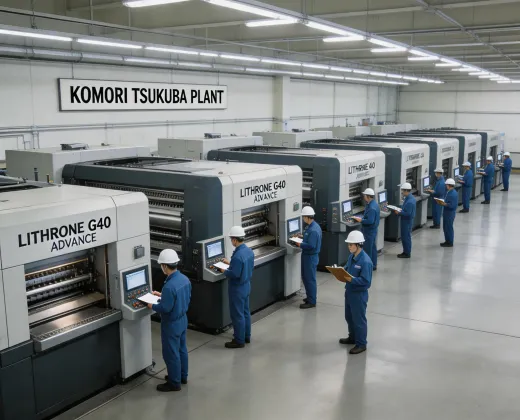
Komori was founded in Kyobashi, Tokyo in 1923. One hundred years later the company still builds printing presses, still calibrates them at Tsukuba against documented reference targets, and still measures its work by how many shifts a customer's press runs before needing a part that isn't on the shelf.
We're an engineering company first, a commercial organization second. Our job is to convert ink-on-substrate physics into a documented commissioning report. Everything else is in service of that line item.
Ten milestones in the Komori story — each chosen because it is a documented engineering fact, not a marketing slogan.
Yoshio Komori establishes the firm as a letterpress manufacturer, beginning a century of press-building centered on the Tokyo printing district.
Post-war transition from letterpress to sheetfed offset aligns Komori with the dominant commercial printing technology of the following decades.
The Lithrone name emerges as Komori's flagship sheetfed offset series — still the flagship more than fifty years later.
Sales, service and Graphicenter infrastructure extended into North America, Europe and South-East Asia as the installed base globalizes.
The Komori Hyper System (KHS) launches as the first integrated make-ready automation platform on Lithrone — an engineering line that leads directly to today's KHS-AI.
Lithrone G / GX series adopts parallel drum transfer, positioning Komori firmly in the folding-carton converter segment.
Komori enters the digital press market with the Impremia UV inkjet family, responding to the commercial digital crossover rather than fighting it.
KP-Connect launches as a cloud-native workflow platform linking prepress, press and finishing KPIs for the plant manager.
Komori marks 100 years of continuous printing-press manufacturing in Kyobashi — one of a small number of global OEMs to reach this milestone.
KHS-AI Advance integrates AI-assisted color control across Lithrone and Impremia platforms. Long-horizon parts policy codifies Komori's commitment to presses already in production.
Every press is commissioned against a written reference target. Every claim has an acceptance-test line item attached to it.
A press bought today should still be serviceable in ten years. Our parts, training and engineering support are architected for that timeline.
Komori Graphicenter is not a showroom — it's a calibration environment where customer substrates, color targets and workflows are tested against our presses.
Bring your substrate, your color target and your production envelope. We'll commission a trial run against your specification, not ours.
Book a Graphicenter Session